Leadership 360: Geometrical Leadership
- Dr Wusu Dumbuya

- Apr 28, 2025
- 5 min read
Leadership is an evolving concept that adapts to the demands of changing organizational structures, workforce expectations, and global dynamics. One innovative approach to leadership is the Geometric Leadership 360 model, where the leader’s position and role are reimagined in a radial, interconnected framework. Unlike traditional hierarchical leadership models, Geometric Leadership emphasizes collaboration, transparency, and shared responsibility, placing the leader at the center of a dynamic network. This paper explores the principles, advantages, challenges, and real-world applications of this model, using the provided illustration as a practical example.
Understanding Geometric Leadership 360
At the core of Geometric Leadership 360 is the idea that the leader serves as a central hub, equidistant from all stakeholders. This geometrical arrangement symbolizes equality in communication and decision-making access (Heifetz, Grashow, & Linsky, 2009). Unlike a top-down structure, where power cascades downward, or a flat structure, where leadership may become ambiguous, Geometric Leadership establishes a clear yet non-dominating central role for the leader.
Key Features of Geometric Leadership 360
Positioning
The leader is situated at the center of the organization, equally connected to every department, team, or stakeholder. This central placement ensures equal access and visibility for all members of the organization (Goleman, 2000). This arrangement eliminates perceptions of favoritism or unequal treatment, fostering an inclusive environment.
Flow of Communication
Communication in this model is multidirectional. The leader listens as much as they speak, fostering an environment of mutual trust and respect. Feedback loops are continuous, enabling real-time adaptation and problem-solving (Bass & Riggio, 2006). Stakeholders feel empowered to voice their concerns and ideas, knowing that the leader values their input.
Decision-Making
Decision-making in Geometric Leadership is collaborative and inclusive. While the leader acts as a facilitator, ensuring alignment with organizational goals, they also prioritize diverse perspectives (Heifetz, Grashow, & Linsky, 2009). By engaging all stakeholders, the leader fosters a sense of shared responsibility and ownership over decisions.
Power Structure
Power in the Geometric Leadership model is distributed across the network, but coordination remains centralized with the leader. This balance allows for collective influence while ensuring that the leader provides direction and maintains organizational coherence (Laloux, 2014).
Goals
The primary goals of Geometric Leadership include:
Enhancing team cohesion and collaboration.
Building trust and transparency across the organization.
Accelerating innovation and responsiveness to challenges.
Empowering team members to contribute meaningfully to organizational success.
The Geometric Leadership Illustration
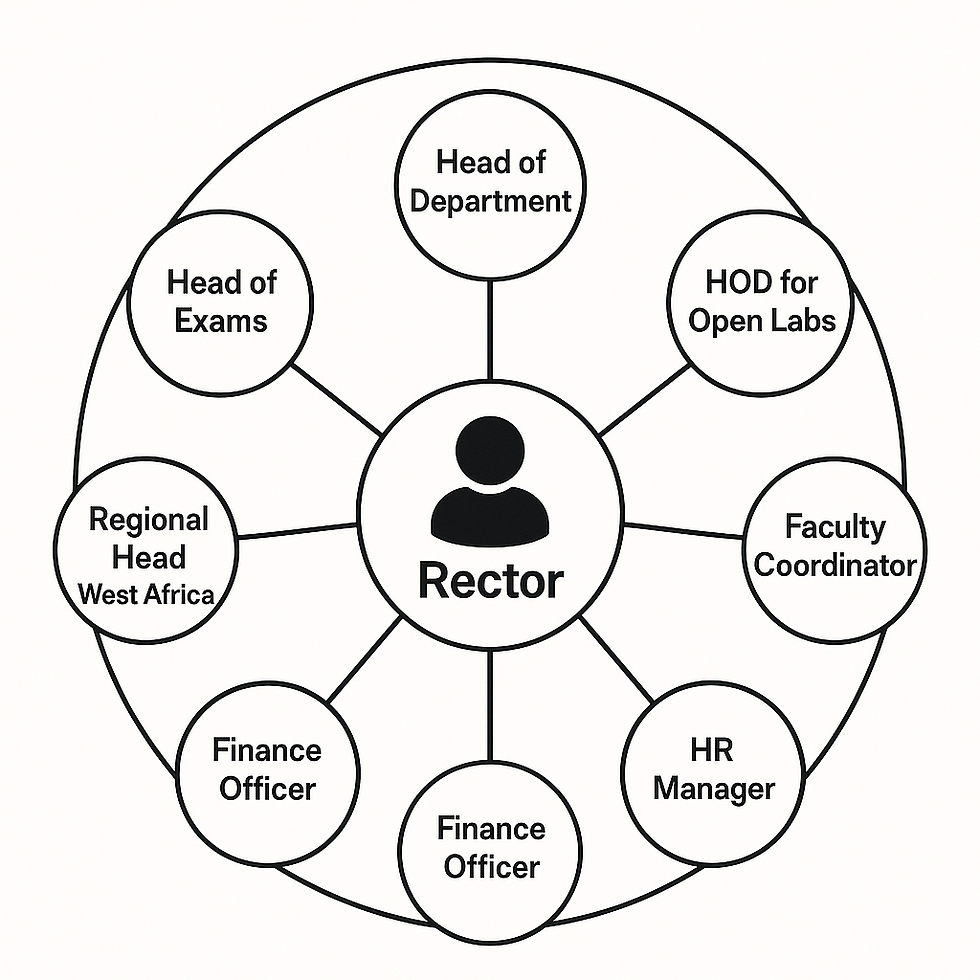
The provided diagram exemplifies the Geometric Leadership 360 model. At the center is the Rector, symbolizing the leader. Surrounding the Rector are key organizational roles: Head of Department, Faculty Coordinator, HR Manager, Finance Officer, Regional Head West Africa, Head of Exams, and HOD for Open Labs. These positions, represented as nodes around the central hub, are directly connected to the Rector, illustrating the radial relationship.
Key Takeaways from the Illustration
Equal Connection: Each role is equally distant from the Rector, reinforcing the principle of equal access.
Role Clarity: While the Rector is central, each surrounding role has distinct responsibilities, contributing to the organization’s overall success (Goleman, 2000).
Collaboration: The structure visually emphasizes collaboration, with all roles interlinked through the central leader.
Benefits of Geometric Leadership 360
Enhanced Communication
Direct and open lines of communication reduce misunderstandings and silos within the organization. Feedback and concerns can be addressed promptly, creating a culture of openness and efficiency (Bass & Riggio, 2006).
Empowerment
Team members feel equally valued and heard, fostering engagement and motivation. By ensuring every stakeholder’s voice is acknowledged, the leader builds a strong foundation of mutual respect (Sinek, 2009).
Agility
The radial structure enables quick decision-making and adaptability, which are essential in dynamic and fast-paced environments. Teams can pivot effectively in response to changes, ensuring the organization remains competitive (Heifetz, Grashow, & Linsky, 2009).
Trust and Transparency
Equal access to the leader builds trust among team members, while transparency in decision-making and communication strengthens the organizational culture (Laloux, 2014). Leaders who exemplify fairness and integrity inspire confidence and loyalty.
Innovation
Collaborative decision-making encourages diverse ideas and creative solutions. By involving stakeholders from various roles, the organization benefits from a wide range of perspectives and expertise (Goleman, 2000).
Challenges of Geometric Leadership 360
Centralized Overload
The leader may become overwhelmed by the volume of direct interactions and responsibilities. Effective delegation and time management are critical to prevent burnout and maintain efficiency (Bass & Riggio, 2006).
Coordination Complexity
Ensuring alignment among diverse roles requires significant effort and skill. The leader must balance competing priorities and mediate conflicts while keeping the organization’s objectives in focus (Heifetz, Grashow, & Linsky, 2009).
Resistance to Change
Shifting from hierarchical models to a geometric structure may face resistance from individuals accustomed to traditional power dynamics. Overcoming this resistance requires clear communication, training, and a gradual implementation strategy (Laloux, 2014).
Scalability
Maintaining the principles of Geometric Leadership in large organizations with numerous stakeholders can be challenging. Leaders must develop systems and processes that uphold the model’s core values while accommodating growth (Sinek, 2009).
Real-World Applications
Organizations implementing Geometric Leadership have reported higher employee satisfaction, improved innovation rates, and better adaptability to market changes. For instance, companies in the tech industry, known for flat and agile structures, have incorporated aspects of this model to balance coordination and empowerment. Educational institutions, as exemplified by the provided illustration, also benefit from this approach by fostering collaboration among faculty and administrative staff.
Case Study: A Technology Firm’s Transition
A mid-sized technology firm transitioned from a hierarchical structure to a Geometric Leadership model to address declining employee engagement and innovation. By positioning the CEO as a central facilitator, the company empowered teams to take ownership of projects while maintaining strategic alignment. Within a year, the firm experienced a 20% increase in employee satisfaction and a 15% rise in new product development (Goleman, 2000).
Geometric Leadership 360 is a forward-thinking approach that redefines the leader’s role from a hierarchical authority to a central facilitator. By fostering equal access, collaboration, and trust, this model aligns with the demands of modern organizations. While challenges exist, its potential to enhance communication, cohesion, and innovation makes it a valuable framework for leaders seeking to adapt and thrive in complex environments. The provided illustration serves as a compelling example of how this model can be visualized and applied in practice.
References
Bass, B. M., & Riggio, R. E. (2006). Transformational Leadership. Psychology Press.
Goleman, D. (2000). Leadership that gets results. Harvard Business Review, 78(2), 78-90.
Heifetz, R., Grashow, A., & Linsky, M. (2009). The Practice of Adaptive Leadership: Tools and Tactics for Changing Your Organization and the World. Harvard Business Press.
Laloux, F. (2014). Reinventing Organizations: A Guide to Creating Organizations Inspired by the Next Stage of Human Consciousness. Nelson Parker.
Sinek, S. (2009). Start with Why: How Great Leaders Inspire Everyone to Take Action. Portfolio.


Comments